Veneto
The Eight Mountains: A NovelVeneto is the family’s remembered rural homeland: the place where the narrator’s mother was born and his father was raised, and the landscape they leave for city life in Milan. Though the story does not return there as a setting, the region persists through the mother’s recollections, the family’s speech and photographs, and songs carried into a new life. It gives the family a past that the narrator inherits indirectly, while remaining distinct from the Dolomites, where his parents’ romance and marriage took shape.
Place of Origin and Departure
The narrator’s parents migrated to Milan in their early thirties, leaving the Veneto countryside behind. His mother had grown up there; his father had been raised there as an orphan of the war. The move was bound up with a change in work and family life, but it did not erase the place from their sense of themselves. Their first mountains and first love were the Dolomites, a separate landscape associated with their courtship: a priest had taken them there as adolescents and later married them at a chapel below Tre Cime di Lavaredo.
The marriage became a family origin story. In October 1972, with a handful of friends and without conventional wedding clothes, the couple spent their first night as husband and wife at the Auronzo refuge. The next day they packed their climbing gear, the mother’s pregnancy, and the father’s new work contract into their car and set out for Milan. Veneto thus belongs to the story as the homeland left behind, while the mountains mark both the beginning of the marriage and the threshold of departure.
The Countryside Preserved in the Mother’s Recollections
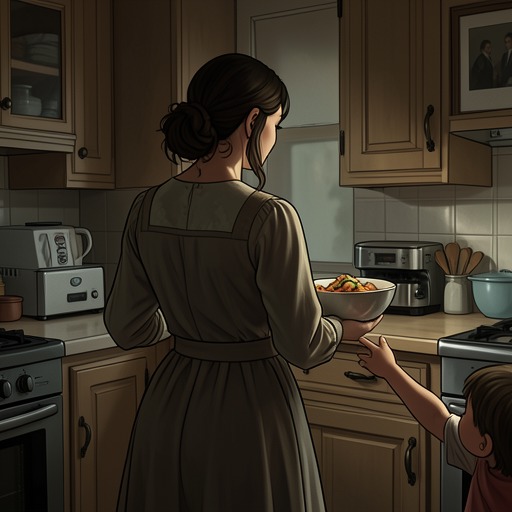
In Milan, the mother passed on Veneto through precise accounts of rural work and seasonal life. While tending flowers on a small, soot-darkened balcony, she told her son about vineyards in August, tobacco leaves hung in a drying kiln, and asparagus that had to be cut before it pierced the soil. Finding the asparagus in time required an unusual skill: recognizing its presence while it was still underground. The recollections make the countryside tangible through labor, crops, and close attention to the land rather than through a generalized nostalgia for rural life.
That attention also links her former and present work. In Veneto she had been a nurse; in Milan she worked as a health worker in a family clinic, supporting women during pregnancy and following newborns through their first year. Her son describes her rural eye as useful in this new role. The continuity does not make the two environments alike: her Milan work took place in a working-class district of crowded housing and serious social hardship. Instead, the remembered countryside accompanies her into a different kind of care and responsibility.
Family Traces in Milan
The family’s Veneto past survived at home in speech and images. The parents continued to speak the dialect of Veneto, which sounded to their son like a private language from a life he had not known. Three photographs displayed in the entrance hall gave that inherited past particular faces and scenes: the mother’s parents on their only trip to Venice; the family gathered in a courtyard during the grape harvest, with baskets full of grapes; and the mother’s brother beside the narrator’s father at a summit cross, dressed for mountaineering with a rope over his shoulder.
The uncle had died young, and the narrator was given his name: he was Pietro, while his uncle had been Piero. Yet the son had met none of the relatives in the photographs. His mother sometimes travelled by train to visit them, returning the following evening a little sadder, before daily obligations resumed. The pictures therefore preserve not a childhood the narrator shared, but a family world he could study without having lived in it.
Songs and the Inherited Past
The past surfaced not only in photographs and dialect but in songs. During long drives through Milan traffic, the mother sometimes began old songs set in the mountains during the Great War, including “The Troop Train,” “The Sugana Valley,” and “The Captain’s Testament.” The narrator learned their stories by heart: twenty-seven men leave for the front and only five return; a mother searches for a cross on the Piave battlefield; a dying man sends a kiss to a betrothed who has eventually married someone else. The songs carried into city life a history and emotional vocabulary that belonged to the parents’ earlier world.
As a child, the narrator sensed that the songs spoke not only of distant soldiers but also, in some unspoken way, of his parents. Their voices disclosed an emotion he could hear before he understood its source. In this way, Veneto is more than a point of origin on a family map: it is a past transmitted through repeated acts of telling, singing, and looking. The son’s connection to it is mediated, but those fragments allow him to recognize that his parents’ city life began with a landscape and a history that continued to shape their family.